
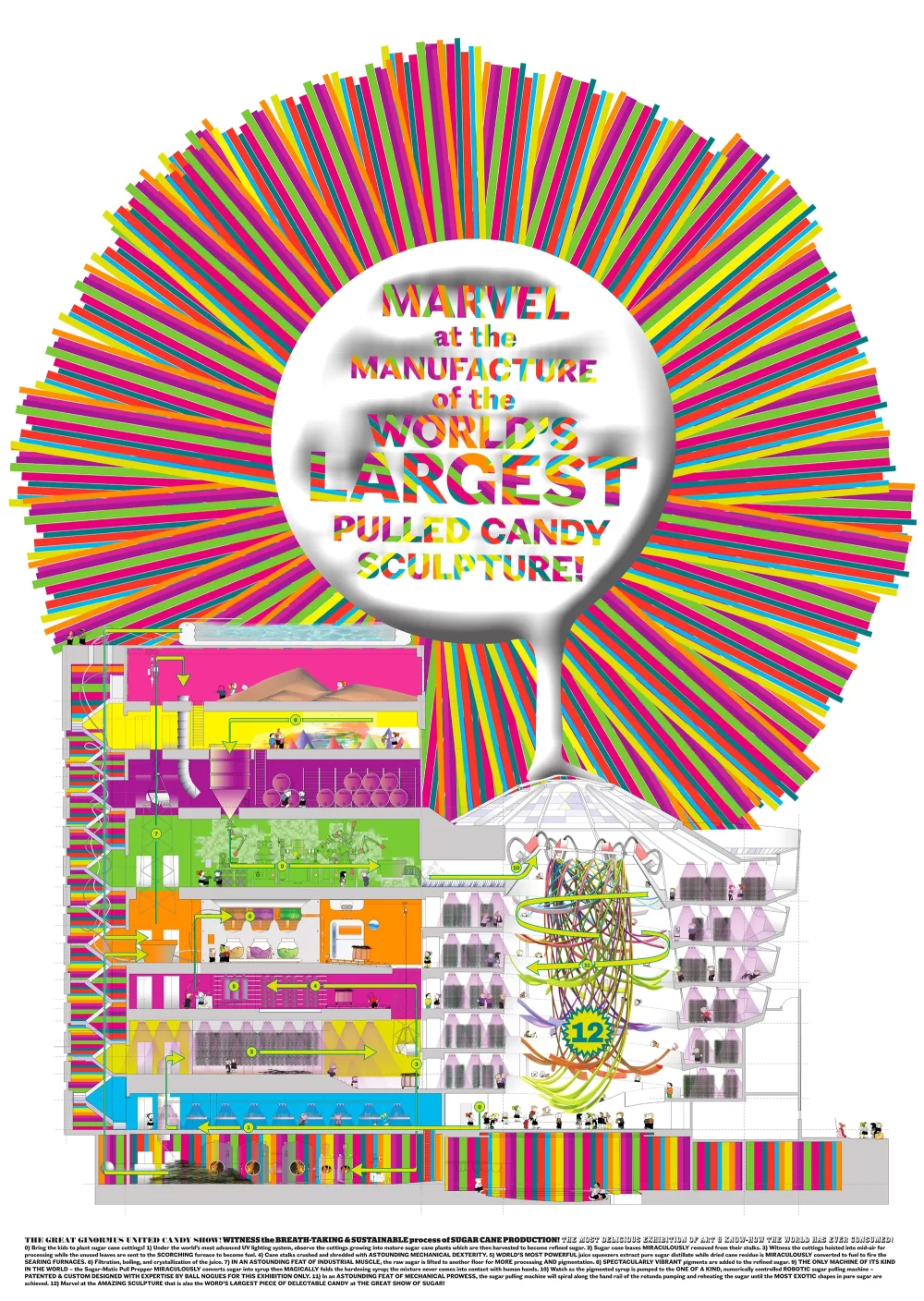
On the occasion of the Guggenheim Museum's 50th anniversary, the museum invited approximately 250 artists, architects, and designers to imagine their dream intervention in Frank Lloyd Wright’s rotunda. A salon-style installation of two-dimensional renderings of these visionary projects emphasized the rich and diverse range of inspired proposals, on view from February 12 through April 28, 2010.
Serving more than one million visitors annually at the Guggenheim’s New York facility—and more than three million worldwide at its other locations—the Guggenheim Museum already presents organized exhibitions of precious cultural artifacts for the general public’s enjoyment and delectation. These exhibitions, often arranged in a linear structure, offer visitors a complex sequence of audio, visual, and textural experiences, imparting a satisfying sense of culture and history. At the conclusion of these exhibitions, visitors are typically directed to the gift shop, where they can acquire books and mementos that further reinforce the narratives presented during their visit.
After careful consideration of the Guggenheim Museum spatially and programmatically, Ball-Nogues Studio recognized the institution’s unique sequence of interconnected galleries and ramps as an architectural form well suited for adaptation as an industrial manufacturing assembly line. Seeking to convert the museum’s current cultural production into a more sustainable manufacturing system, Ball-Nogues Studio proposed adapting Wright’s masterwork into a contraption for the transformation of raw, organic sugar cane into a delectable candy confection—an art installation and industrial expo that is both easy to eat and delicious.
The proposed re-use acknowledges the imperative for architects to carefully appropriate and preserve the noted structure while adapting it economically and functionally using new green technologies and systems. That Wright designed the structure, a priori, to suit this pressing contemporary need is, for Ball-Nogues, proof enough that form follows function.
Principals in Charge: Benjamin Ball, Gaston Nogues
Project Team: Tim Peeters, Andrew Lyon, Nicole Semenova, Benlloyd Goldstein
Graphic Design Collaboration: Jessica Fleischmann of Still Room